
Authored by the free version of ChatGPT:
Jhumpa Lahiri’s “Sexy” is a story without many easy answers. Miranda becomes involved with Dev even though she knows he is married, which immediately puts her choices into morally questionable territory. But Lahiri does not make Miranda—or Dev, for that matter—easy to categorize as simply good or bad. Miranda is lonely and searching for connection, while Dev gives her a glimpse into a culture and part of the world that she had previously known only from a distance. Understanding her motivations does not necessarily excuse her choices, but it does make them more complicated.
That complexity is what makes me think about the idea of moral greyness. Instead of asking whether Miranda is right or wrong, the story encourages us to consider why she makes the choices she does and how her perspective changes throughout the story. There is a lot of space between completely innocent and completely guilty.
I also see a connection to digital humanities through the story’s use of geography and maps. Miranda encounters Bengal through Dev, first through a map and The Economist and later through places like the Mapparium. Geography becomes a way for Miranda to understand a culture—and, in some ways, Dev himself. The Mapparium is particularly interesting because the experience changes depending on where Miranda stands. What she sees is shaped by her position.
That idea of perspective connects both parts of my reading. Whether we are mapping places or judging people, our position influences what we see. “Sexy” reminds us that neither geography nor morality is always as straightforward as a map might make it appear.
(329 words)
My reflection:
I chose to have an AI author this assignment because, quite honestly, I am struggling to understand how it ties into digital humanities or this class as a whole. To me, it simply read like a piece of fiction, which is a valid and expansive genre, but neither the subject matter nor the formatting presented worthwhile elements of digital humanities to me.
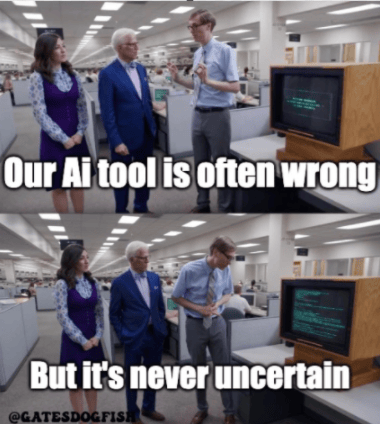
Because I was both confused by this assignment and curious how ChatGPT would handle a similarly confusing situation, I used this blog as one of my three AI-generated posts for the semester. I assumed that ChatGPT (the free version) would make a subpar, weak connection between this class and the assigned reading merely because ChatGPT does not say, “No, that’s not possible,” or “I am not sure that I understand the connection”—it will spew something out regardless of quality.
And, in my opinion, my hypothesis was correct. I prompted the AI to draft something about both moral greyness and digital humanities as they relate to the content of this reading. I asked for a 250-word blog post (it wrote 329, which was somewhat surprising) and a title that matches the tone of a blog post. I went through probably thirty titles before ChatGPT spit out one that I didn’t hate. Maybe I should have just gone with the first one that it gave, but since my name is still attached to this work, I at least wanted the title to be somewhat interesting.
Now, regarding the post itself: The first line sucks. ChatGPT wrote, “Jhumpa Lahiri’s “Sexy” is a story without many easy answers.” Yes. Most quality works of writing operate under the same criteria. This perfectly encapsulates my point regarding an AI’s inability to say “I do not understand the connection.” Instead, it will write something vague and ramble on until some kind of conclusion is drawn and some volta pointed out. The rest of the first paragraph is—at large—a brief literary analysis. Admittedly I have not read much in the genre of blog, but from my understanding, most bloggers focus more so on their own reactions to something—assuming that their audience has familiarity with the subject or the ability to Google anything they do not already know. Again, this could be a misreading on my part, but had I written the analysis, I would not have included so much contextual detail.
The second paragraph restates the last line of the first paragraph, and is essentially and utterly a waste of both time and space. I think it just wanted to force the words “moral greyness” into the blog post because that was the verbiage I used when prompting ChatGPT. The same can be said about paragraph three; I do not believe that ChatGPT would have ever mentioned digital humanities if I did not explicitly prompt it to do so. The connections are weak, really relying on a single mention of The Economist and a few mentions of maps and geography to tie in digital humanities.
In sum, I do not think this was a solid response from ChatGPT. But I don’t think the blame is entirely on AI here. I don’t think this reading—isolated and without context—makes sense in the confines of this class. If I as a human cannot make sense of this assignment, there is little to no hope in prompting a robot to draw those same connections.
(565 words)
 Lia King
Leave a comment